


In the shadow of the second Israel-Iran war within a year, the Israeli-Palestinian conflict is once again sidelined. Since the Gaza ceasefire agreement in last October, some important regional developments have taken place, mainly regarding Iran, but also regarding Israel’s broader impact on the region. Yet in war-torn Gaza, almost nothing has changed on the ground.
This stasis serves two purposes. For the Israeli government and military, it sustains a war mindset and the appearance of achievement, keeping an otherwise embattled government politically afloat. For Hamas, every day without active fighting – albeit also without political change or reconstruction is another day the leadership can dismiss or suppress internal criticism and any meaningful discussion of its role in the Palestinian national struggle.
It is therefore urgent to amplify diverse voices from within the humanitarian catastrophe in Gaza and raise awareness of the deep and dangerous changes underway in the West Bank.
In light of the absence of these topics from the mainstream Israeli media, in the past two months we have published Hebrew-language analyses of Hamas’s own narrative, the criticisms levelled at it, and different visions for Gaza’s future, alongside field reports and research on the West Bank.
Infrastructure remains destroyed – almost no electricity, no running water, almost no fuel. Even banknotes wear out, making intact bills a sought-after commodity on the black market
Gaza: Neither Here Nor There
The months since the Gaza ceasefire have placed the Strip in a strange limbo. Ground advances, occupation and destruction have been largely halted along a poorly defined “yellow line”. The bombings have decreased significantly, and larger amounts of aid and goods enter through the crossings – some officially, some smuggled. Yet fighting has certainly not stopped: near-daily strikes are recorded; more than 600 Palestinians have been killed and over 1,600 injured since the ceasefire.
Smadar Ben-Natan brought the testimony of her friend Iyad (pseudonym), a Gazan father of four, offering an unmediated view of this reality.
Iyad describes sky-high food prices, the end of food distribution by international organizations, and a total ban on fishing. Infrastructure remains destroyed – almost no electricity, no running water, almost no fuel. Even banknotes wear out, making intact bills a sought-after commodity on the black market.
Health services operate at extremely low capacity; diseases spread due to severe shortage of medicines combined with raw sewage on the streets. The accumulated material and mental damage of the war will be felt for generations. Yet in Israel, there is hardly any serious discussion about the future of the Gaza Strip and its residents, and the only coherent vision seems to be the rightwing dream of ethnic cleansing.
The document focuses on Hamas’s claimed consciousness-raising successes: a surge in international support for Palestinians. The fact that this outcome is due largely to the brutality of Israel’s own attacks and the great suffering they inflicted on Gazans is downplayed
As testimonies from Gaza receive scant attention in Israeli media, Israelis are not aware of the different voices within Palestinian discourse about the war. For this reason we published a thorough analysis of Hamas’s document “Our Narrative”, whose second part was published in late December 2025, and of the reactions to it in Gazan society.
Forum fellow Yaniv Ronen’s analysis of the document reached a key conclusion: the document seeks to frame 7 October and the war as a demonstration of Hamas’s strength and success, but it primarily reveals the movement’s weakness.
Whereas the first part of the document, published in January 2024, is defensive, responding to accusations of recklessness and of crimes against Israelis – the second frames October 7 as a integral consequence of a long Palestinian national struggle against Zionist oppression, occupation and siege.
According to Ronen, “Our Narrative” is also meant to serve as a declaration of victory after two and a half years of resistance. It focuses on Hamas’s claimed consciousness-raising successes: a surge in international support for Palestinians, Israel’s framing as a perpetrator of genocide and colonialism and resulting erosion of international support. The fact that these outcomes are due largely to the brutality of Israel’s own attacks and the great suffering they inflicted on Gazans is downplayed.
The discounting of the unimaginable destruction and death toll in Gaza reveals the weakness of the narrative Hamas is trying to construct.
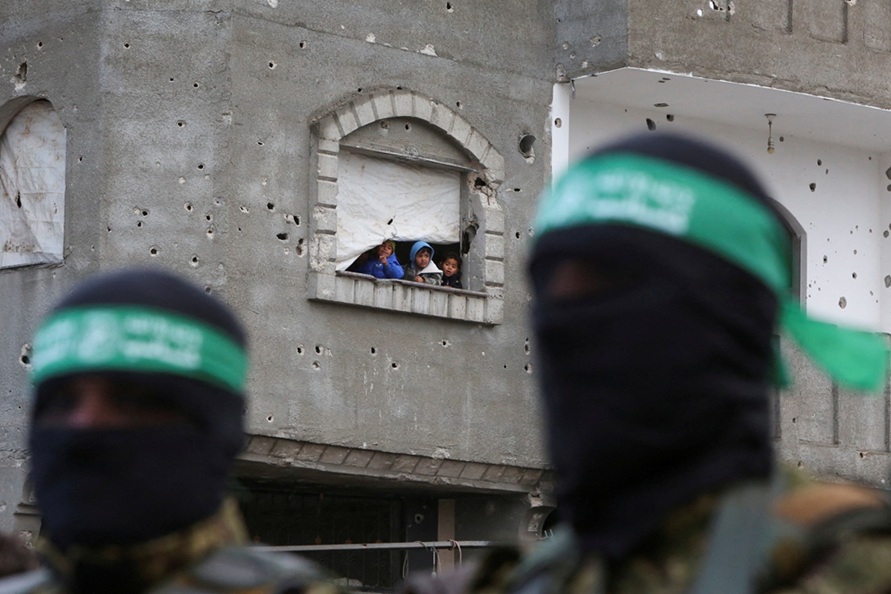
al-Dayah criticized the recklessness of launching the attack, arguing that Islamic law required Muslim leaders not to carelessly endanger their people in a war against a vastly superior force
The Fatwa Resisting Hamas
Hamas’s narrative faced rival voices from within Gazan society. About a year ago, the so-called “Mufti of Gaza”, Sheikh Salman al-Dayah – Dean of the Faculty of Islamic Law at the Islamic University of Gaza and former Minister of Endowments in the Hamas government – called for an end to the war and harshly criticized Hamas’s decision to launch the October 7 attack.
This was not merely a media statement: it took the form of a deeply reasoned fatwa (Islamic legal ruling) grounded in al-Dayah’s interpretation of the duties of jihad. One of the most prominent criticisms from within the Islamist movement of 7 October, the fatwa ignited wide controversy across the Islamic movement in Gaza and beyond.
We published an annotated translation of the fatwa focused on its central lines of criticism. First, al-Dayah criticized the recklessness of launching the attack, arguing that Islamic law required Muslim leaders not to carelessly endanger their people in a war against a vastly superior force. Second, he criticized the habit of Hamas leaders to defame Palestinians who criticize them, and defended Gazans’ right to return to the prewar period. Third, he accused Hamas leaders of misreading the situation: they achieved none of their goals yet boast of successes on the backs of suffering Gazans, treating that suffering with contemptuous indifference.
Al-Dayah stated that the awareness-raising achievements abroad – the core of “Our Narrative” – are simply not worth the suffering and death inflicted by Israel. Finally, he noted that even without this enormous price, these achievements had not impressed Israel or prevented it from continuing its actions.
A review published by Elitzur Gluck in January shows prominent Palestinian and Gazan voices in the media questioning Hamas’s victory declarations. Much like al-Dayah, these writers accuse Hamas of making an absurd gamble with the lives of Gaza’s residents based on imaginary power relations, then doubling down and refusing to acknowledge its mistakes.
Meanwhile, control has quickly reverted to Hamas in its old form in parts of the Strip unoccupied by the IDF
Some argue that Hamas’s attack has spun out of control – that had the movement’s leaders believed it would lead to a war of destruction they would not have launched it. According to this view, Hamas and its leaders are guilty of miscalculation and loss of control at best; at worst, they are reckless individuals who have staked tens of thousands of souls on a single throw of the dice.
Another article by Bar Greenberg, published in February, describes extensive criticism of Hamas by Palestinian journalists, including supporters of armed resistance. The central argument they make is that even if spontaneous resistance to occupation is unavoidable, and even if armed struggle is justified in itself, the leaders of that struggle bear responsibility for making rational decisions and must be held accountable for failure.
This thread runs through every response to Hamas’s positions: the movement’s leaders take no responsibility for the catastrophe, despite the fact that its roots lie in the very decision to launch 7 October.
Meanwhile, control has quickly reverted to Hamas in its old form in parts of the Strip unoccupied by the IDF. A review published by Itay Malach describes the speed and brutality with which opponents of Hamas, those accused of collaboration with anti-Hamas Israeli-funded militia members and are being suppressed.
Summary executions are all over the social media, highlighting the enduring political divisions in Palestinian society. Consequently, many withdraw from independent political initiatives or criticism of Hamas. At the same time, Hamas supporters emphasize how the movement is reestablishing itself as the only entity holding real governing power in Gaza, which must therefore be part of “the day after”.
A Blueprint for Dignity: A Gazan Voice for Change
Rivaling these grim outlooks and the emerging reality, we published in February an article by Jasser Abu-Musa, who offers an active vision for change addressed to Donald Trump’s Board of Peace. Abu-Musa is a political analyst writing from the perspective of someone who has spent his entire life in Gaza and has coped with the loss of his wife, two sons, mother and sister.
He explains that from the start of the Israeli blockade in 2007 until 2023, Gaza became increasingly suffocated, fragmented and pressured to a breaking point. But that Gaza no longer exists; in its stead is a devastated society deprived of its survival needs and subjected to collective trauma.
Abu-Musa calls for a fundamental change in approach: not Hamas, not Israel, but a genuine international stabilization force to maintain security and order, under a Palestinian civilian council that would promote physical, structural and spiritual reconstruction.
This would require a significant strengthening of Gazan civil society, genuine economic rehabilitation, and a real guarantee of a free and secure future for Gaza’s citizens – not a return to a besieged Gaza, but a new socioeconomic structure allowing for development. He calls on the international community to recognize the injustices of the past two decades, not only those of the war, and assume a moral obligation to act toward reconstruction.
For now, however, almost nothing of what Abu-Musa calls for is realized. The Strip remains neither here nor there – a limbo that is by all appearances convenient for Israel’s government, which can thereby continue maintaining a permanent state of war.
Abu-Musa calls on the international community to recognize the injustices of the past two decades, not only those of the war, and assume a moral obligation to act toward reconstruction
The West Bank: Dangerous Changes Below the Radar
While no one seems willing or able to change the status quo in Gaza, the West Bank is undergoing a massive and radical transformation. Exacerbated with the rise of the current far-right government in Israel, the war in Gaza overshadowed that transformation and allowed extremist ministers Bezalel Smotrich and Itamar Ben Gvir, the settler leadership, the IDF and settler “hilltop youth” gangs to intensify their onslaught on Palestinian society without international or domestic scrutiny.
In January, we published an analysis on the background of the settlement structure and its economic impact on Palestinians. In this review of economic and historical research papers, I looked at the lesser-known impacts of the settlements.
The review suggested that not only are they used as part of the Israeli repression mechanism in the West Bank, but they are also a vast economic machine used for extraction of resources, land, equity and cheap labor from the West Bank Palestinians – largely for the benefit of settler economic elites.
This comes at the expanse of economic growth prospects for the Palestinians, as they are denied control of water, gas, electricity and even stone quarries. Along with the chokehold of Israeli institutions both military and civilian on the Palestinian economy, this is a major factor in the poverty rampant in the West Bank, especially near settlements.
Not only are the settlements used as part of the Israeli repression mechanism in the West Bank, but they are also a vast economic machine used for extraction of resources, land, equity and cheap labor from the West Bank Palestinians
The combination of enduring poverty and the cancellation of most work permits for West Bank Palestinians in Israel since October 7 has deepened a sub-economy of corruption and exploitation around work permits.
An investigative report published in the liberal Al-Araby Al-Jadeed, reviewed by On Dahan, exposes an entire industry that has grown around so-called “Permit 00” – a special security permit issued by Israeli authorities to Palestinians who have assisted the Shin Bet, allowing movement between the West Bank and Israel. The investigation reveals how holders of such permits sell them to middlemen and speculators in the West Bank, who in turn sell them for a vast profit to desperate Palestinian workers who lost their work permits when the war broke.
Alongside the economic and legal architecture of dispossession, we also examined how the line between settlers and soldiers is being deliberately blurred on the ground. In a new article, Yonatan Kanonich unpacks the phenomenon of settlers in uniform – reservists, emergency response squad members and armed civilians in IDF dress – whose presence turns regional defense into an instrument of territorial expansion and population control.
Drawing on a recent Yesh Din report and rare Israeli indictments, Kanonich shows how this creates a fog of responsibility in which it is almost impossible for Palestinians, or for the Israeli law enforcement, such that there is, to know whether an assailant is a soldier, a policeman or a civilian, and therefore to hold anyone to account.
This policy-made ambiguity, he argues, turns armed settlers into an unofficial arm of the state, enabling organized violence and land seizure while shielding decision-makers from direct responsibility for any harm done to Palestinian individuals and communities in the West Bank.
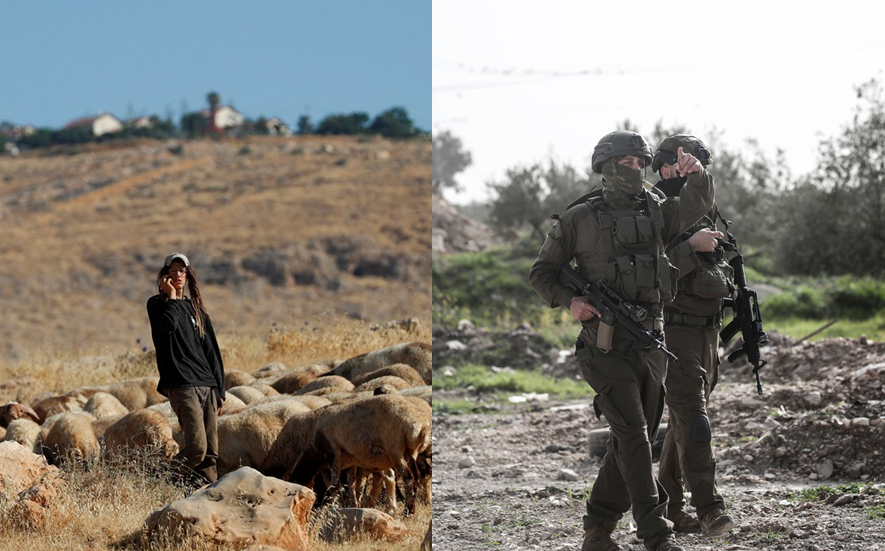
This policy-made ambiguity, he argues, turns armed settlers into an unofficial arm of the state, enabling organized violence and land seizure while shielding decision-makers from direct responsibility
From a different angle, we looked at the exploitation of children and youth as a labor and fighting force in the settler outpost farms, sent to harass and attack Palestinian communities. An investigation published recently in Haaretz exposed this systematic use of children, sometimes under 15, to harass, intimidate, surveil and sabotage Palestinian communities, clearing the way for more serious attacks and ultimately for the displacement of those communities.
Yehezkel Lein analyses the legal implications. International humanitarian law is unequivocal: recruiting children under 15 into a fighting force or using them in active participation in hostilities constitute war crimes. The ICC’s landmark 2012 conviction of militia leader Thomas Lubanga established that “participation in hostilities” includes support roles, from intelligence gathering to deliveries.
The reality of children living in outposts fits this definition closely. Lein notes that states such as Germany and Sweden, which exercise universal jurisdiction, have adopted a stricter standard than the ICC’s age-15 threshold, enabling the prosecution of recruiters through parallel charges such as human trafficking or criminal negligence.
Days after the expose was published, the residents of Ras al-Ayn in the southern Jordan Valley began dismantling their homes and dispersing – like some sixty other Palestinian communities in the past two years alone.
Looking Ahead
The picture that emerges from these reviews is that Palestinians in both the West Bank and Gaza bear the costs of Israeli political inaction and military ruthlessness. The diverse voices we have amplified in these months — al-Dayah, Abu-Musa, Palestinian journalists, legal analysts – all share a common insistence: the current trajectory is neither inevitable nor sustainable.


